Monday, February 23, 2009

I lost the toss

Jonathan here. My February 3 post, Will the Dow Set a New low in 2009, is the most stupid post I've ever written. Not because my thesis was wrong (it was), but in our line of work, focusing on process over outcome is what it's all about, and in the clarity of hindsight, I was focusing on outcome not process. So now that I've had my whipping, eaten crow, and been avoided at the water cooler by my colleagues, I wanted to share just a bit about what we know and think about market sentiment, or more precisely, investor sentiment. Sage investors know investors become buyers when the consensus gets cheerful. Warren Buffett said "you pay a high price for a cheerful consensus." Ben Graham, Buffett's mentor and teacher, urged his apprentice to "buy when there's blood in the streets", or words to that effect.

Clearly, anybody who's followed that kind of advice has had his head handed to him on a platter. For going on a year now, it seems like the crowd has been right and buyers or holders of stocks have gotten it all wrong. "Will this persist?" (like it looks like it will) is the wrong question to be asking. "How long will it last?" is, I believe, the right question.

We've heard that history repeats itself. With all the focus on what's happening now in the stock market, it seems that investors have, once again, pretty much discounted what's happened long, long ago. But that's not unusual; we're all prone to a bout with Outcome Bias every now and again. "It's different this time," we hear, ad nauseam. Yes, events are different this time. But human nature hasn't changed one whit in the last 1,000 years, and I seriously doubt it will before 2009 rolls to a close.

To that end, we've poured a lot of time into studying bullish and bearish sentiment and investor pain. Believing that investors really are predictably irrational, we want to learn what happened when investors sold stocks when everything was dismal and when they bought stocks when everything was rosy. I'm far from ready to offer any conclusions, but I'm happy to share our initial findings here.

If these charts pique your interest, your comments are welcome. Similarly, if you drop us a line, we'd be happy to chat.


If these charts pique your interest, your comments are welcome.  Similarly, if you drop us a line, we'd be happy to chat.

Tuesday, February 03, 2009

Will the Dow set a new low in 2009?

Call me old fashioned, but I think there are safer and surer ways to get paid while waiting than to own a contract, valued at approximately 79 cents on 2/3/2009, betting that the Dow will set a low that is lower than 7,449.38 sometime between now and year end. 

With stocks at multi-year lows and investor pain at multi-year highs, I'm pretty sure that going long the Intrade contract is not a bet I'd want to take...but that's what makes a market.  If I understand the value proposition correctly, the buyer who's willing to pay ~ 80 cents to own this contract, now believes that there's an 80% chance that he'll see lower lows than 7,449.38 sometime this year.  Conversely the seller who's willing to sell this contract for ~ 80 cents now believes that there's a 20% chance that he'll see lower lows than 7,449.39 this year.  See Disclosure and more beneath chart.  

Price for Dow to Trade at New Low in 2009 at intrade.com

[Disclosure - Jonathan Smith doesn't own this, or any, contract on Intrade (or any other prediction market) and isn' making any recommendations, bets, conjectures, whatsoever. For the record, his dowsing stick isn't any better than anybody else's. Intrade.com is a prediction market, and much ado has been made by the media about prediction markets. In case you're wondering what sort of payoff the buyer of the aforesaid contract gets for his ~ 80 cent investment if he wins. The answer is $1.00. On the other side of the transaction, the seller who sold the contract got ~ 80 cents for being willing to pay a buck if he loses. After he subtracts the ~ 80 cents he gets to keep from the buck he might have to pay out, he'll be out ~ 20 cents, and so you could say he thinks there's a 20% chance the Dow will go south of 7,449.38 in '09.]

By the way, this chart used with permission by Intrade.com.

Thursday, January 22, 2009

"The Worst Quarter Since 1931" - Q4 2008 Commentary

The tremors that began over a year and a half ago in the mortgage market came to fruition in the stock and bond markets this past fall. The fourth quarter of 2008 was the worst quarter for the stock market in the 308 calendar quarters since 1931. Diversification, that friend of investors through thick or thin, did little to avert the damage. Even uncorrelated investments moved lockstep in one direction: down.

During the quarter, panicked investors fled any investment perceived to have risk. Prices of stocks and corporate bonds, under more pressure from sellers than from buyers, dropped to valuation levels not seen in decades. By November, under the weight of perpetual political campaigns, shorter days, and longer lists of bailouts, investor panic heightened. An index that tracks stock price volatility reached a new high last quarter, a level not seen since October 1987. Even money market funds were perceived as risky.


And then, at 8:30 am on December 11th, two weeks before Christmas, the world was stunned by the news of the arrest of Bernard L. Madoff on charges of running the largest investor fraud ever committed by a single individual. “The Madoff affair,” wrote Thomas L. Friedman, “is the cherry on top of a national breakdown in financial propriety, regulations and common sense.”

So if you’re looking for the recipe for that pit in the stomach of the average investor, it goes something like this: add once in a lifetime stock and bond market losses, throw in an investor scam of mammoth proportions, mix it with unprecedented government intervention, add a dash of a bleak economic outlook and a pinch of bank failures, top it all off with a depressed housing market and serve it up on CNBC. That’s more than enough to make us sick, and we haven’t even discussed foreign markets yet!


Given all that has transpired we keep going back to the basics, our research, and our calculators. At the forefront of our research we remember that in the best and worst of economic times emotions, not fundamentals, determine stock market prices. In contrast, during ordinary times, the underlying business values determine stock market prices.


What’s an investor to do? Follow his heart? By no means! Regular readers of this commentary know that we often write about our admiration for Warren Buffett. His investment approach has proven successful in good markets and in bad. He recently made headlines for writing an essay in the New York Times encouraging investors to “Buy American.” He said:

“The financial world is a mess, both in the United States and abroad. Its problems, moreover, have been leaking into the general economy, and the leaks are now turning into a gusher. In the near term, unemployment will rise, business activity will falter and headlines will continue to be scary. So ... I’ve been buying American stocks.”
Buffett is no cheerleader. A dispassionate investor whose primary job is allocating capital, Buffett has made serious comments about the market only four times in his career. The chart below demonstrates both his ability and his patience.

We agree with Buffett. We have seen businesses selling for less than the cash in the company – yet there are few buyers because buyers are fearful. When Wachovia Bank, an institution that did not close during the great depression, teeters on the brink of collapse and virtually eliminates their cash dividend, it’s hard to know whom or what to trust.

World governments have taken steps to improve liquidity and credit markets are beginning to function rationally. There is evidence the crisis is beginning to subside but the financial system is still fragile and the economic news is likely to be pretty grim for the next few quarters.


The question we have to answer is this: do we have the time horizon and patience necessary to hold a company’s stock until that company’s value is realized? When stock prices move up or down 25% in one day or even several days, it’s quite apparent that underlying business values aren’t driving those price changes; confused people are driving those price changes. At some point, panic will subside and investors will begin (again) to pay attention to asset values, and when they do, share prices will adjust. So far in 2009 we’ve already seen a number of stocks that have risen over 75% in just the first three trading days. This is a sign that panic is subsiding.


Going forward, we’re keeping in front of us the words of Nick Murray:

“Less than 5% of an investor’s lifetime total return will come from what his investments did versus other, similar investments. The other 95% will come from how the investor behaved, and the primary determinant of that behavior will be the quality of advice he got, or didn't get.”
We take seriously our responsibility to our clients and our responsibility for how we behave in the midst of a period of tumult. All of our research, experience, and instinct tell us that today is a day to be invested and not sitting on the sidelines. As Mr. Buffett said in the same op-ed piece, “A simple rule dictates my buying, be fearful when others are greedy, and be greedy when others are fearful.”

To read more commentaries and learn more about Jonathan Smith & Co., visit http://www.jonathansmith.com/resources.cfm

Monday, January 12, 2009

Sign of the times

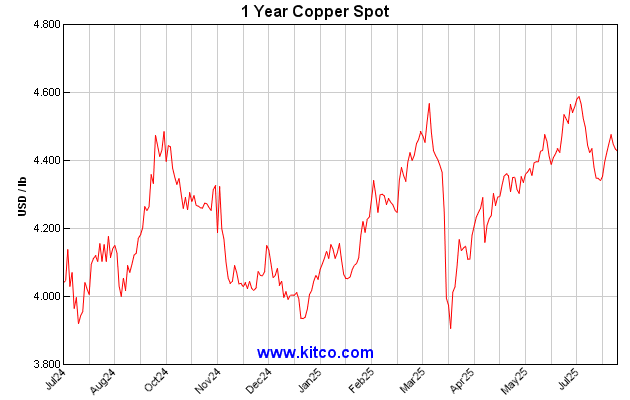
Jonathan here. This week the recession hit home. It’s official. We know this because the copper lights on our company sign were wrenched off their mounting posts this weekend. I guess when the price for recycled copper cratered from over $4 in June to just a little over a buck now, the copper poachers figured it’s not worth straining too hard for salvage copper when there’s plenty of low hanging fruit easy reach.

Another sign of the times, more reliable than my copper sign light index caught my eye.

The email invited me to check out Amazon.com's year-end book deals. “Save big on the books you love,” the teaser read. So I did.

I remember years ago checking out Amazon’s book deals. Once, I recall, Amazon was peddling John Bogle’s book, “Bogle on Investing," for something like 70% off.

Bogle the value investor had then just published a book about his first 50 years in the business (Bogle, you may know, was founder and CEO of the Vanguard family of mutual funds, and was, is, and forever will be impervious to any urge whatsoever to time the stock market.) With dot-com stocks then flying high, I guess Amazon figured who in their right mind would want to read a book about value investing of all things, which is probably why the cut the price and this little gem of a book wound up the bargain table.

In thirty-two years in the investment business I've never heard anyone ring a bell when we've reached the “top” or the “bottom” of a market cycle. What I was about to see made me wonder if Bogle’s “value investing” book (on sale for 30% of “fair value”) was as good as any “bell” I would ever hear. After all, that little priced book just happened to coincide with what history would recognize as the peak of the dot-com bubble.

“Save big on the books you love,” read the recent flyer. Drawn by the sidebar featuring bargain books in the very category I was sure to like (cooking), I bit.  And there it was, just like (well, almost like) the one my mother in law gave us 37 ½ years ago: a Rival Crock pot and a copy of Rival Crock Pot: 3 books in 1, the most popular selling book in the bargain book cooking category, the 3rd most popular selling book in the cooking appliances category, and the 500th most popular selling book in the whole Amazon.com universe.

If Bogle’s book on the bargain counter signaled the bursting of the dot-com bubble, could the reawakening of stocks be too far behind the Rival Recession Index?
I was over at my favorite Sears store this weekend in the tool department in pursuit of a 21/64ths black oxide drill bit to finish drilling a light sign I made for Anne. Whenever I can't find what I’m looking for, an affable and able salesman named Jim is available to help me. Jim, I am sure, knows everything there is to know about tools and a thing or two besides. It's obvious he likes helping people, 3) works because, in his own words, “I’d go crazy if he had to sit around all day doing nothing,” 4) knows a heck of a lot about stocks and stock market valuations. He should. He’s 80!

If I’m lucky and Jim’s not too busy, I can usually pull a nugget or two of wisdom out of him, wisdom beyond that of the tool realm. And so I slipped my crock-pot theory on him, recounting how back in 2000, Amazon.com had slashed the price of John Bogle’s value investing book because, after all, nobody wanted it and now, Rival’s Crock Pot, paired with a three in one blockbuster book, was setting the slow-cooking woods on fire.  “Jim,” I said, “How's the old the crock pot selling these days?” He cocked his head and looked at me as if I had read his mind. “Son,” he said, “we sold so many Crock Pots this Christmas we just about quit putting them up on the shelves and let the customers go outside and pick ‘em up off the truck.” He added that for a little while, he was pretty sure no one Sear’s customer was going to get a chance to get near a crock pot, on account of all of Sear’s employees snapping them up before they were released to the public.

Monday, December 29, 2008

Pick-a-Pay Loans

Justin here. One of the worst financial inventions to come out of the housing boom has been the "Pick A Pay" loan.

Basically, the homeowner picks a payment they feel comfortable with, then they just pay it; it's as easy as that. You get a low payment, increasing house value, and big biceps (see picture) . . . well, not really.

What happens most of the time is that the homeowner is actually paying less than the interest! So the principal, instead of going down with every payment, actually GOES UP! You are essentially borrowing more money monthly. This was all well and good (though still not smart) while home values were rising. You can guess what happens when the house starts falling.

In May 2008, a San Francisco news station did a segment spotlighting the training videos that the company used (video here). It shows a scene where the homeowner asks the loan officer to clarify that he won't actually be paying down principal with this loan and the recommended response is "it's optional".

(Note: The company shown in the video was bought by another bank, which was bought by another bank, which then suspended the pick-a-pay program and then got bought by yet another bank.)

Friday, December 12, 2008

Recipe for Disaster: Keeping Up With The Joneses

Justin here. The single best (and by far most fascinating) explanation I've found of the current financial crisis is This American Life’s The Giant Pool of Money episode that aired on NPR. (You can listen to the 30 second promo here, the full story here, or read the transcript here.)

Mostly because excerpts like this:

“I wouldn't have loaned me the money. And nobody that I know would have loaned me the money. I know guys who are criminals who wouldn't loan me that and they break your knee-caps. I don’t know why the bank did it. I’m serious ... $540,000 to a person with bad credit.”

It made me realized that the sole cause of the crisis (literally ... the ... sole ... cause) is this: the need to keep up with the Joneses.

At every level of the chain: from countries needing to boost their investment returns so they sell out of treasuries and go to higher yielding alternatives, to homeowners taking out mortgages and second mortgages because their neighbors and friends are, to mortgage brokers creating riskier and riskier loans because their competition are, to banks buying those mortgages because the other banks are buying them.

The desire to “keep up” overtook the need to act rationally. I urge you to read or listen to it. Below are some more excerpts (emphasis mine) and my key takeaway:

"An interesting fact, here. Mike Garner's bank did not care how risky these mortgages were. This was the new era: banks didn't have to hold on to these mortgages for 30 years. They didn’t have to wait and see if they’d be paid back. Bank's like Garner's just owned them for a month or two and then sold them on to Wall Street. Wall Street would sell them on to the global pool of money."

And this:

"No income no asset loans. That's a liar's loan. We are telling you to lie to us. We're hoping you don't lie. Tell us what you make, tell us what you have in the bank, but we won't verify? We’re setting you up to lie. Something about that feels very wrong. It felt wrong way back when and I wish we had never done it. Unfortunately, what happened ... we did it because everyone else was doing it."

And lastly, this about the current and future landscape:

"The global pool of money is avoiding anything with even the slightest hint of risk and that affects everybody, no matter who you are. It's harder to borrow money to buy a house, or build a factory, or bring your country boldly into the 21st century."
My key takeaway is this: things are generally not as good or as bad as they seem.

Translation: if Mr. Market underpriced risk on the outset of this mess (ie - he bought risky securities he shouldn’t have), is it so crazy to think that Mr. Market could overprice risk today (ie – Mr. Market might not be buying some low risk securities that he should be buying?)