It seemed like a really great idea at first. And it actually was, but somewhere along the way, it turned bad, really bad. I’m not quite sure when, but it was either before or after a tenant started breeding Pit Bulls in the back bedroom . . . well, now that I say that, it was probably before. The story starts a good six years before the Pit Bulls. I was just finishing my freshman year in college. Four friends and I were looking for an apartment that would rent to five college kids, but no one would go above four (that should have been my first hint). So I hatched an idea and floated it past Jonathan (side note: I quit referring to him as “Dad” after my first day of work here). I proposed that we use my first-time homebuyer status to get a cheap loan, then buy a four bedroom condo, cover our mortgage with the rent from my four roommates, and on graduation day we’d easily sell it and voila, three years of rent free living. I was, as we say, very bullish.
It worked well for the first three years. In addition to the rent working out as planned, I happened to meet my wife, Millie, who was living in the building next door (I later learned she had made the same proposal to her Mom and they owned her condo also – the serendipity!) Three years later, my roommates became my groomsmen when Millie and I married a month after graduation and, even though we couldn’t sell the condo right away, we found some decent tenants to tide us over for “just a few months.”
That first batch of tenants sent their checks in on time and didn’t scuff up the walls too badly. But as we continued to rent it out while looking for a buyer, we discovered each group of tenants brought new troubles. Our costs went up: carpets had to be cleaned after each tenant, washers broke, and rooms were painted black. And our emotional expense went up as well: lost sleep over dealing with missed rents and worry over our exit price. All the while our potential liabilities piled up: the smoke detectors went unattended, the 3rd floor porch railing was removed for an impromptu golf driving range, and of course the aforementioned Pit Bull husbandry. Thankfully, the world is full of enterprising young men with four friends who want to live together – we were lucky enough to sell our place to one such “investor” well before the housing market collapsed.
Friday, July 23, 2010
Looking at Investing Through the Eyes of a Landlord


Thursday, November 26, 2009
Everything I Needed to Know . . .

Monday, February 23, 2009
I lost the toss
Jonathan here. My February 3 post, Will the Dow Set a New low in 2009, is the most stupid post I've ever written. Not because my thesis was wrong (it was), but in our line of work, focusing on process over outcome is what it's all about, and in the clarity of hindsight, I was focusing on outcome not process. So now that I've had my whipping, eaten crow, and been avoided at the water cooler by my colleagues, I wanted to share just a bit about what we know and think about market sentiment, or more precisely, investor sentiment. Sage investors know investors become buyers when the consensus gets cheerful. Warren Buffett said "you pay a high price for a cheerful consensus." Ben Graham, Buffett's mentor and teacher, urged his apprentice to "buy when there's blood in the streets", or words to that effect.
Clearly, anybody who's followed that kind of advice has had his head handed to him on a platter. For going on a year now, it seems like the crowd has been right and buyers or holders of stocks have gotten it all wrong. "Will this persist?" (like it looks like it will) is the wrong question to be asking. "How long will it last?" is, I believe, the right question.
We've heard that history repeats itself. With all the focus on what's happening now in the stock market, it seems that investors have, once again, pretty much discounted what's happened long, long ago. But that's not unusual; we're all prone to a bout with Outcome Bias every now and again. "It's different this time," we hear, ad nauseam. Yes, events are different this time. But human nature hasn't changed one whit in the last 1,000 years, and I seriously doubt it will before 2009 rolls to a close.
To that end, we've poured a lot of time into studying bullish and bearish sentiment and investor pain. Believing that investors really are predictably irrational, we want to learn what happened when investors sold stocks when everything was dismal and when they bought stocks when everything was rosy. I'm far from ready to offer any conclusions, but I'm happy to share our initial findings here.
If these charts pique your interest, your comments are welcome. Similarly, if you drop us a line, we'd be happy to chat.
If these charts pique your interest, your comments are welcome. Similarly, if you drop us a line, we'd be happy to chat.
Monday, January 12, 2009
Sign of the times
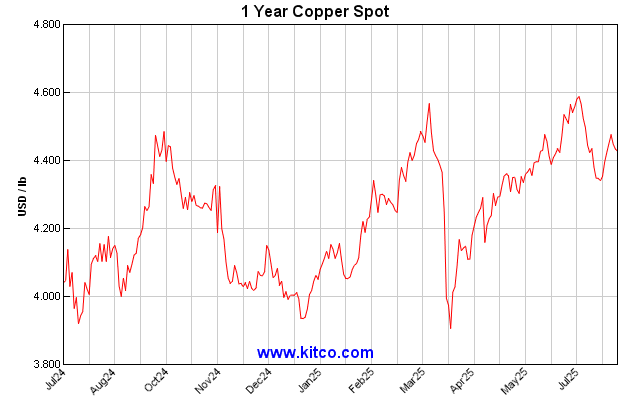 Jonathan here. This week the recession hit home. It’s official. We know this because the copper lights on our company sign were wrenched off their mounting posts this weekend. I guess when the price for recycled copper cratered from over $4 in June to just a little over a buck now, the copper poachers figured it’s not worth straining too hard for salvage copper when there’s plenty of low hanging fruit easy reach.
Another sign of the times, more reliable than my copper sign light index caught my eye.
The email invited me to check out Amazon.com's year-end book deals. “Save big on the books you love,” the teaser read. So I did.
 I remember years ago checking out Amazon’s book deals. Once, I recall, Amazon was peddling John Bogle’s book, “Bogle on Investing," for something like 70% off.
Bogle the value investor had then just published a book about his first 50 years in the business (Bogle, you may know, was founder and CEO of the Vanguard family of mutual funds, and was, is, and forever will be impervious to any urge whatsoever to time the stock market.) With dot-com stocks then flying high, I guess Amazon figured who in their right mind would want to read a book about value investing of all things, which is probably why the cut the price and this little gem of a book wound up the bargain table.
In thirty-two years in the investment business I've never heard anyone ring a bell when we've reached the “top” or the “bottom” of a market cycle. What I was about to see made me wonder if Bogle’s “value investing” book (on sale for 30% of “fair value”) was as good as any “bell” I would ever hear. After all, that little priced book just happened to coincide with what history would recognize as the peak of the dot-com bubble.

 “Save big on the books you love,” read the recent flyer. Drawn by the sidebar featuring bargain books in the very category I was sure to like (cooking), I bit. And there it was, just like (well, almost like) the one my mother in law gave us 37 ½ years ago: a Rival Crock pot and a copy of Rival Crock Pot: 3 books in 1, the most popular selling book in the bargain book cooking category, the 3rd most popular selling book in the cooking appliances category, and the 500th most popular selling book in the whole Amazon.com universe.
If Bogle’s book on the bargain counter signaled the bursting of the dot-com bubble, could the reawakening of stocks be too far behind the Rival Recession Index?
 I was over at my favorite Sears store this weekend in the tool department in pursuit of a 21/64ths black oxide drill bit to finish drilling a light sign I made for Anne. Whenever I can't find what I’m looking for, an affable and able salesman named Jim is available to help me. Jim, I am sure, knows everything there is to know about tools and a thing or two besides. It's obvious he likes helping people, 3) works because, in his own words, “I’d go crazy if he had to sit around all day doing nothing,” 4) knows a heck of a lot about stocks and stock market valuations. He should. He’s 80!
If I’m lucky and Jim’s not too busy, I can usually pull a nugget or two of wisdom out of him, wisdom beyond that of the tool realm. And so I slipped my crock-pot theory on him, recounting how back in 2000, Amazon.com had slashed the price of John Bogle’s value investing book because, after all, nobody wanted it and now, Rival’s Crock Pot, paired with a three in one blockbuster book, was setting the slow-cooking woods on fire. “Jim,” I said, “How's the old the crock pot selling these days?” He cocked his head and looked at me as if I had read his mind. “Son,” he said, “we sold so many Crock Pots this Christmas we just about quit putting them up on the shelves and let the customers go outside and pick ‘em up off the truck.” He added that for a little while, he was pretty sure no one Sear’s customer was going to get a chance to get near a crock pot, on account of all of Sear’s employees snapping them up before they were released to the public.



 Posts
Posts

