Showing posts with label market sentiment. Show all posts

Monday, February 23, 2009

I lost the toss

Jonathan here. My February 3 post, Will the Dow Set a New low in 2009, is the most stupid post I've ever written. Not because my thesis was wrong (it was), but in our line of work, focusing on process over outcome is what it's all about, and in the clarity of hindsight, I was focusing on outcome not process. So now that I've had my whipping, eaten crow, and been avoided at the water cooler by my colleagues, I wanted to share just a bit about what we know and think about market sentiment, or more precisely, investor sentiment. Sage investors know investors become buyers when the consensus gets cheerful. Warren Buffett said "you pay a high price for a cheerful consensus." Ben Graham, Buffett's mentor and teacher, urged his apprentice to "buy when there's blood in the streets", or words to that effect.

Clearly, anybody who's followed that kind of advice has had his head handed to him on a platter. For going on a year now, it seems like the crowd has been right and buyers or holders of stocks have gotten it all wrong. "Will this persist?" (like it looks like it will) is the wrong question to be asking. "How long will it last?" is, I believe, the right question.

We've heard that history repeats itself. With all the focus on what's happening now in the stock market, it seems that investors have, once again, pretty much discounted what's happened long, long ago. But that's not unusual; we're all prone to a bout with Outcome Bias every now and again. "It's different this time," we hear, ad nauseam. Yes, events are different this time. But human nature hasn't changed one whit in the last 1,000 years, and I seriously doubt it will before 2009 rolls to a close.

To that end, we've poured a lot of time into studying bullish and bearish sentiment and investor pain. Believing that investors really are predictably irrational, we want to learn what happened when investors sold stocks when everything was dismal and when they bought stocks when everything was rosy. I'm far from ready to offer any conclusions, but I'm happy to share our initial findings here.

If these charts pique your interest, your comments are welcome. Similarly, if you drop us a line, we'd be happy to chat.


If these charts pique your interest, your comments are welcome.  Similarly, if you drop us a line, we'd be happy to chat.

Tuesday, February 03, 2009

Will the Dow set a new low in 2009?

Call me old fashioned, but I think there are safer and surer ways to get paid while waiting than to own a contract, valued at approximately 79 cents on 2/3/2009, betting that the Dow will set a low that is lower than 7,449.38 sometime between now and year end. 

With stocks at multi-year lows and investor pain at multi-year highs, I'm pretty sure that going long the Intrade contract is not a bet I'd want to take...but that's what makes a market.  If I understand the value proposition correctly, the buyer who's willing to pay ~ 80 cents to own this contract, now believes that there's an 80% chance that he'll see lower lows than 7,449.38 sometime this year.  Conversely the seller who's willing to sell this contract for ~ 80 cents now believes that there's a 20% chance that he'll see lower lows than 7,449.39 this year.  See Disclosure and more beneath chart.  

Price for Dow to Trade at New Low in 2009 at intrade.com

[Disclosure - Jonathan Smith doesn't own this, or any, contract on Intrade (or any other prediction market) and isn' making any recommendations, bets, conjectures, whatsoever. For the record, his dowsing stick isn't any better than anybody else's. Intrade.com is a prediction market, and much ado has been made by the media about prediction markets. In case you're wondering what sort of payoff the buyer of the aforesaid contract gets for his ~ 80 cent investment if he wins. The answer is $1.00. On the other side of the transaction, the seller who sold the contract got ~ 80 cents for being willing to pay a buck if he loses. After he subtracts the ~ 80 cents he gets to keep from the buck he might have to pay out, he'll be out ~ 20 cents, and so you could say he thinks there's a 20% chance the Dow will go south of 7,449.38 in '09.]

By the way, this chart used with permission by Intrade.com.

Monday, January 12, 2009

Sign of the times

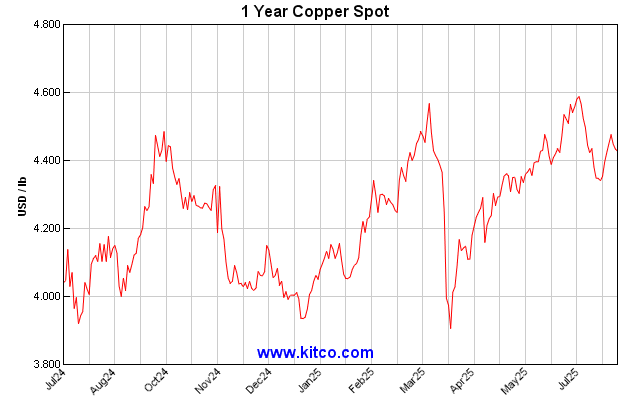
Jonathan here. This week the recession hit home. It’s official. We know this because the copper lights on our company sign were wrenched off their mounting posts this weekend. I guess when the price for recycled copper cratered from over $4 in June to just a little over a buck now, the copper poachers figured it’s not worth straining too hard for salvage copper when there’s plenty of low hanging fruit easy reach.

Another sign of the times, more reliable than my copper sign light index caught my eye.

The email invited me to check out Amazon.com's year-end book deals. “Save big on the books you love,” the teaser read. So I did.

I remember years ago checking out Amazon’s book deals. Once, I recall, Amazon was peddling John Bogle’s book, “Bogle on Investing," for something like 70% off.

Bogle the value investor had then just published a book about his first 50 years in the business (Bogle, you may know, was founder and CEO of the Vanguard family of mutual funds, and was, is, and forever will be impervious to any urge whatsoever to time the stock market.) With dot-com stocks then flying high, I guess Amazon figured who in their right mind would want to read a book about value investing of all things, which is probably why the cut the price and this little gem of a book wound up the bargain table.

In thirty-two years in the investment business I've never heard anyone ring a bell when we've reached the “top” or the “bottom” of a market cycle. What I was about to see made me wonder if Bogle’s “value investing” book (on sale for 30% of “fair value”) was as good as any “bell” I would ever hear. After all, that little priced book just happened to coincide with what history would recognize as the peak of the dot-com bubble.

“Save big on the books you love,” read the recent flyer. Drawn by the sidebar featuring bargain books in the very category I was sure to like (cooking), I bit.  And there it was, just like (well, almost like) the one my mother in law gave us 37 ½ years ago: a Rival Crock pot and a copy of Rival Crock Pot: 3 books in 1, the most popular selling book in the bargain book cooking category, the 3rd most popular selling book in the cooking appliances category, and the 500th most popular selling book in the whole Amazon.com universe.

If Bogle’s book on the bargain counter signaled the bursting of the dot-com bubble, could the reawakening of stocks be too far behind the Rival Recession Index?
I was over at my favorite Sears store this weekend in the tool department in pursuit of a 21/64ths black oxide drill bit to finish drilling a light sign I made for Anne. Whenever I can't find what I’m looking for, an affable and able salesman named Jim is available to help me. Jim, I am sure, knows everything there is to know about tools and a thing or two besides. It's obvious he likes helping people, 3) works because, in his own words, “I’d go crazy if he had to sit around all day doing nothing,” 4) knows a heck of a lot about stocks and stock market valuations. He should. He’s 80!

If I’m lucky and Jim’s not too busy, I can usually pull a nugget or two of wisdom out of him, wisdom beyond that of the tool realm. And so I slipped my crock-pot theory on him, recounting how back in 2000, Amazon.com had slashed the price of John Bogle’s value investing book because, after all, nobody wanted it and now, Rival’s Crock Pot, paired with a three in one blockbuster book, was setting the slow-cooking woods on fire.  “Jim,” I said, “How's the old the crock pot selling these days?” He cocked his head and looked at me as if I had read his mind. “Son,” he said, “we sold so many Crock Pots this Christmas we just about quit putting them up on the shelves and let the customers go outside and pick ‘em up off the truck.” He added that for a little while, he was pretty sure no one Sear’s customer was going to get a chance to get near a crock pot, on account of all of Sear’s employees snapping them up before they were released to the public.

Saturday, September 27, 2008

The Doctor is In

Ron Lieber knows value when he sees it.  Not intrinsic value, but examination value.  In his feature article in today's New York Times, he says good financial advisors have the examination skills of an ace psychologist.  I've heard financial advisors called lots of things, but I haven't often heard them called keen observers of minds and money.  Lieber rounded up a bunch of planners and advisors who got their starts as psychologists or studied the field as graduate students. 
Lest you think I fall into either of those categories let me assure you neither I nor anyone else in my firm started as a psychologist nor studied psychology in graduate school.  We have, however, spent hundreds of hours with psychologists, some spent on their couches trying to understand our own quirks and biases, but hundreds more spent with clients, psychologists, and psychiastrists on our couches, though fortunately not all at the same time.  Meir Statman taught us how to "make science our ally".  From Dan Ariely, we've discovered how hidden forces direct our minds in the making of decisions that are predictably irrationalCFA Institute provides us with a digital library filled with presentations on economics, finance, and behavioral psychology, explained by world-class experts in their fields.
We take our calling seriously and have asked more than one client to encounter professional therapy, and our reading room has served as a makeshift emergency room for more than one financial intervention, the most memorable of which included: the client couple, her therapist, his therapist, their accountant, our management team, and their small group.  (I'm just glad the fire department didn't pop in that day, checking expiration dates on fire extinguishers and rounding up frayed extension cords, if they had, they would have had to join up with our recovery group (hey what's a few more people?), never mind leaving a fire truck parked on the curb with its flashers on.  We look back on that day with fondness and gratitude; each participant shone, contributed magnificently, and on that day, the hero (the husband) and the heroine (the wife) put a stake in the ground, changed the river course for good, and re-wrote the history books of their lives.    

Lieber's feature is worth the read.  He shows real advisors in a light neither the newspapers nor the talking heads know anything about, maybe because it doesn't sell advertisements.  Growing money is a process that doesn't happen overnight, it takes years and decades, not days.  Check the article out here.

Most of you reading this post can take comfort in the reality that time on your side is the best insurance policy against volatility and permanent loss of capital. Some of you can't, maybe time isn't on you side.  No psychology sheepskins here, just authentic, wise, and caring people, alumni of the bear markets, the emergency room, and the trenches of real life.

If anybody knows of any other articles about financial advisors serving as financial therapists, please leave leave a comment or drop us a line. 

Monday, July 21, 2008

Market sentiment and anxiety 07172008


The AAII sentiment survey (membership required) measures the percentage of individual investors who are bullish, bearish, and neutral on the stock market short term; individuals are polled from the AAII Web site on a weekly basis. Only one vote per member is accepted in each weekly voting period.
For the week ending July 16, bullish sentiment rose to 25.00% from 22.17%, equal to 1.29 standard deviations below the mean. Bearish sentiment rose to 58.14%, equal to 2.9 standard deviations above the mean. Anxiety Index rose from -11.9% to -8.8%, equal to 0.47 standard deviations below the mean. Click chart to resize.

Sunday, July 13, 2008

Market sentiment and anxiety 07102008

The AAII sentiment survey (membership required) measures the percentage of individual investors who are bullish, bearish, and neutral on the stock market short term; individuals are polled from the AAII Web site on a weekly basis. Only one vote per member is accepted in each weekly voting period.

Sentiment data is displayed along with a proprietary anxiety index. The chart above includes something that the AAII version doesn’t. Click chart to resize.

At every date along the X Axis of this chart, you can see what the S&P500 did one year out from that date. For example, if you put your finger on the X axis on October 19, 1990, for example, and then moved your finger up to where the S&P500 intersects with that date, you’ll see that the S&P500, in the 12 months following, was up 26%. During the last 21 years there have been 14 or so occurrences where negative sentiment outweighed positive sentiment, and by a pretty big margin. (Resize chart by clicking and dragging handles.)

Couldn't help noticing Tuesday David Tice agreed to sell his David W. Tice & Associates investment management firm to Federated Investors Inc. for up to $142.5 million. Is this this pure coincidence or did Tice decide bearish sentiment was high enough (and bullish sentiment low enough) to sell out? Tice, who founded the Prudent Bear and Global Income Fund in 1995, will remain with Federated Investors. The purchase price, if certain conditions are met, could be 8.53% of assets under management. Is that a record? Guess Tice knows how to run a Bear fund, and a thing or two besides.
