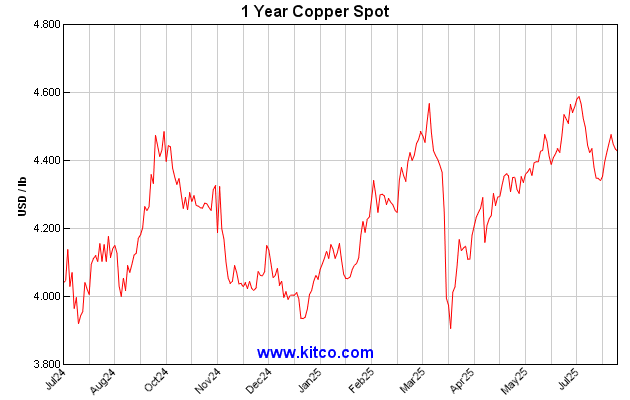
 Jonathan here. This week the recession hit home. It’s official. We know this because the copper lights on our company sign were wrenched off their mounting posts this weekend. I guess when the price for recycled copper cratered from over $4 in June to just a little over a buck now, the copper poachers figured it’s not worth straining too hard for salvage copper when there’s plenty of low hanging fruit easy reach.
Another sign of the times, more reliable than my copper sign light index caught my eye.
The email invited me to check out Amazon.com's year-end book deals. “Save big on the books you love,” the teaser read. So I did.
 I remember years ago checking out Amazon’s book deals. Once, I recall, Amazon was peddling John Bogle’s book, “Bogle on Investing," for something like 70% off.
Bogle the value investor had then just published a book about his first 50 years in the business (Bogle, you may know, was founder and CEO of the Vanguard family of mutual funds, and was, is, and forever will be impervious to any urge whatsoever to time the stock market.) With dot-com stocks then flying high, I guess Amazon figured who in their right mind would want to read a book about value investing of all things, which is probably why the cut the price and this little gem of a book wound up the bargain table.
In thirty-two years in the investment business I've never heard anyone ring a bell when we've reached the “top” or the “bottom” of a market cycle. What I was about to see made me wonder if Bogle’s “value investing” book (on sale for 30% of “fair value”) was as good as any “bell” I would ever hear. After all, that little priced book just happened to coincide with what history would recognize as the peak of the dot-com bubble.

 “Save big on the books you love,” read the recent flyer. Drawn by the sidebar featuring bargain books in the very category I was sure to like (cooking), I bit. And there it was, just like (well, almost like) the one my mother in law gave us 37 ½ years ago: a Rival Crock pot and a copy of Rival Crock Pot: 3 books in 1, the most popular selling book in the bargain book cooking category, the 3rd most popular selling book in the cooking appliances category, and the 500th most popular selling book in the whole Amazon.com universe.
If Bogle’s book on the bargain counter signaled the bursting of the dot-com bubble, could the reawakening of stocks be too far behind the Rival Recession Index?
 I was over at my favorite Sears store this weekend in the tool department in pursuit of a 21/64ths black oxide drill bit to finish drilling a light sign I made for Anne. Whenever I can't find what I’m looking for, an affable and able salesman named Jim is available to help me. Jim, I am sure, knows everything there is to know about tools and a thing or two besides. It's obvious he likes helping people, 3) works because, in his own words, “I’d go crazy if he had to sit around all day doing nothing,” 4) knows a heck of a lot about stocks and stock market valuations. He should. He’s 80!
If I’m lucky and Jim’s not too busy, I can usually pull a nugget or two of wisdom out of him, wisdom beyond that of the tool realm. And so I slipped my crock-pot theory on him, recounting how back in 2000, Amazon.com had slashed the price of John Bogle’s value investing book because, after all, nobody wanted it and now, Rival’s Crock Pot, paired with a three in one blockbuster book, was setting the slow-cooking woods on fire. “Jim,” I said, “How's the old the crock pot selling these days?” He cocked his head and looked at me as if I had read his mind. “Son,” he said, “we sold so many Crock Pots this Christmas we just about quit putting them up on the shelves and let the customers go outside and pick ‘em up off the truck.” He added that for a little while, he was pretty sure no one Sear’s customer was going to get a chance to get near a crock pot, on account of all of Sear’s employees snapping them up before they were released to the public.






 Posts
Posts

