Showing posts with label behavioral finance. Show all posts

Tuesday, February 03, 2009

Will the Dow set a new low in 2009?

Call me old fashioned, but I think there are safer and surer ways to get paid while waiting than to own a contract, valued at approximately 79 cents on 2/3/2009, betting that the Dow will set a low that is lower than 7,449.38 sometime between now and year end. 

With stocks at multi-year lows and investor pain at multi-year highs, I'm pretty sure that going long the Intrade contract is not a bet I'd want to take...but that's what makes a market.  If I understand the value proposition correctly, the buyer who's willing to pay ~ 80 cents to own this contract, now believes that there's an 80% chance that he'll see lower lows than 7,449.38 sometime this year.  Conversely the seller who's willing to sell this contract for ~ 80 cents now believes that there's a 20% chance that he'll see lower lows than 7,449.39 this year.  See Disclosure and more beneath chart.  

Price for Dow to Trade at New Low in 2009 at intrade.com

[Disclosure - Jonathan Smith doesn't own this, or any, contract on Intrade (or any other prediction market) and isn' making any recommendations, bets, conjectures, whatsoever. For the record, his dowsing stick isn't any better than anybody else's. Intrade.com is a prediction market, and much ado has been made by the media about prediction markets. In case you're wondering what sort of payoff the buyer of the aforesaid contract gets for his ~ 80 cent investment if he wins. The answer is $1.00. On the other side of the transaction, the seller who sold the contract got ~ 80 cents for being willing to pay a buck if he loses. After he subtracts the ~ 80 cents he gets to keep from the buck he might have to pay out, he'll be out ~ 20 cents, and so you could say he thinks there's a 20% chance the Dow will go south of 7,449.38 in '09.]

By the way, this chart used with permission by Intrade.com.

Monday, January 12, 2009

Sign of the times

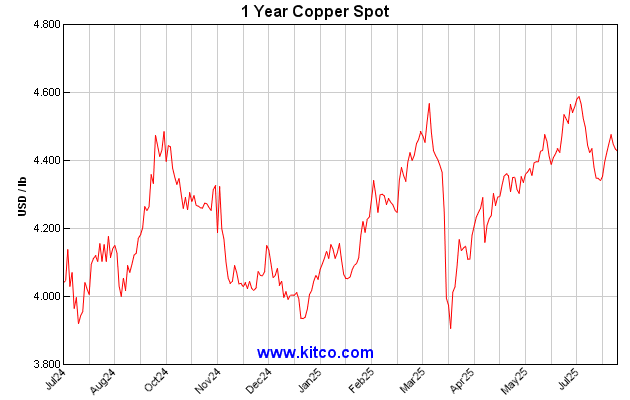
Jonathan here. This week the recession hit home. It’s official. We know this because the copper lights on our company sign were wrenched off their mounting posts this weekend. I guess when the price for recycled copper cratered from over $4 in June to just a little over a buck now, the copper poachers figured it’s not worth straining too hard for salvage copper when there’s plenty of low hanging fruit easy reach.

Another sign of the times, more reliable than my copper sign light index caught my eye.

The email invited me to check out Amazon.com's year-end book deals. “Save big on the books you love,” the teaser read. So I did.

I remember years ago checking out Amazon’s book deals. Once, I recall, Amazon was peddling John Bogle’s book, “Bogle on Investing," for something like 70% off.

Bogle the value investor had then just published a book about his first 50 years in the business (Bogle, you may know, was founder and CEO of the Vanguard family of mutual funds, and was, is, and forever will be impervious to any urge whatsoever to time the stock market.) With dot-com stocks then flying high, I guess Amazon figured who in their right mind would want to read a book about value investing of all things, which is probably why the cut the price and this little gem of a book wound up the bargain table.

In thirty-two years in the investment business I've never heard anyone ring a bell when we've reached the “top” or the “bottom” of a market cycle. What I was about to see made me wonder if Bogle’s “value investing” book (on sale for 30% of “fair value”) was as good as any “bell” I would ever hear. After all, that little priced book just happened to coincide with what history would recognize as the peak of the dot-com bubble.

“Save big on the books you love,” read the recent flyer. Drawn by the sidebar featuring bargain books in the very category I was sure to like (cooking), I bit.  And there it was, just like (well, almost like) the one my mother in law gave us 37 ½ years ago: a Rival Crock pot and a copy of Rival Crock Pot: 3 books in 1, the most popular selling book in the bargain book cooking category, the 3rd most popular selling book in the cooking appliances category, and the 500th most popular selling book in the whole Amazon.com universe.

If Bogle’s book on the bargain counter signaled the bursting of the dot-com bubble, could the reawakening of stocks be too far behind the Rival Recession Index?
I was over at my favorite Sears store this weekend in the tool department in pursuit of a 21/64ths black oxide drill bit to finish drilling a light sign I made for Anne. Whenever I can't find what I’m looking for, an affable and able salesman named Jim is available to help me. Jim, I am sure, knows everything there is to know about tools and a thing or two besides. It's obvious he likes helping people, 3) works because, in his own words, “I’d go crazy if he had to sit around all day doing nothing,” 4) knows a heck of a lot about stocks and stock market valuations. He should. He’s 80!

If I’m lucky and Jim’s not too busy, I can usually pull a nugget or two of wisdom out of him, wisdom beyond that of the tool realm. And so I slipped my crock-pot theory on him, recounting how back in 2000, Amazon.com had slashed the price of John Bogle’s value investing book because, after all, nobody wanted it and now, Rival’s Crock Pot, paired with a three in one blockbuster book, was setting the slow-cooking woods on fire.  “Jim,” I said, “How's the old the crock pot selling these days?” He cocked his head and looked at me as if I had read his mind. “Son,” he said, “we sold so many Crock Pots this Christmas we just about quit putting them up on the shelves and let the customers go outside and pick ‘em up off the truck.” He added that for a little while, he was pretty sure no one Sear’s customer was going to get a chance to get near a crock pot, on account of all of Sear’s employees snapping them up before they were released to the public.

Tuesday, November 18, 2008

The House is Falling

Justin here. When my wife and I moved to Greensboro, we looked at 10 or 15 houses before making an offer on the cheapest one of the lot. After finding out there were two other offers, we paid the asking price ($129,900) for the 110 year old bungalow that had an abundance of charm and lead paint but skimped on the closet space and bathrooms.

Almost four years, one baby, 6 restored windows and a new paint job later, I'm still scurrying across the house at 6:00am to get to my closet, one that was made for a man with much narrower shoulders than me.

Anyway, when the stock market is moving like it is now, we've found it helpful to think about stock prices in terms of home prices. We've often asked clients, "What if you had a ticker running across your screen telling you what your home was worth? What if Jim Cramer screamed about your home price on TV? What if Barron's did a story about how overvalued your house was?" You'd start to believe everything they say.

Enter Zillow, a website that is supposed to track the daily price of your house. Zillow has been out a while, but I only got around to looking up my house in the last few months (below is the 5 year chart, that circle withe the $ is where I bought the house.)

And when I looked at it, do you want to know what I felt? Regret. Seriously. I regretted buying it for more than zillow said it was 'worth' ($115,000) and regretted not selling it in May 2008 when it was 'worth' $164,000.

But, you want to know what else I felt? Relief. Seriously. I was relieved to not have gotten the email, seen the quote, or heard the news that my house was 'worth' only $120,000 in February of 2007. Relieved that I didn't panic and sell out after it "when down" 15% from my purchase price. Relieved that I knew what my house was really worth and didn't sell for less.

And then I realized that looking at Zillow is no different than reading a stock analyst report, listening to a talking head, or checking your stock portfolio daily. The analysts and talking heads might sound slick and have a clean looking chart, but chances are they don't know the real value. And your stock portfolio today is only a snapshot of what someone will pay you right now, not a true measure of what is is worth. We think the prices we'll see in 6, 12, 18, 24, heck even if it takes 36 months (which is still long before the bulk of us will need to use our investments) will tell a much different story that the 'quotes' we're getting today.

Try telling the seller of my house that it was only worth $115,000 the day before he sold it - that's what Zillow said it was worth. I think he'd argue that my bank's check to him for $129,900 is a lot more accurate than Zillow's "quote." For him, his house ended up being worth about 13% more than Zillow quoted. Would it surprise you if we had the same thing going on in the stock market today, but on a much larger scale?

Ben Graham, the father of value investing, Mr. Market, and Warren Buffett's investing career, once said:

"The investor who permits himself to be stampeded or unduly worried by unjustified market declines . . . would be better off if his stocks had no market quotation at all, for he would then be spared the mental anguish caused him by other persons' mistakes of judgment."
Words worth remembering, especially now.

Question: What Are You Doing?

Justin here. American Public Media's Marketplace has been asking different people that question ("what are you doing?") since the start of this financial crisis. Today, they asked one of our favorite people: Dan Ariely

In this three minute 'interview' (listen below) Dan says that he has decided to not look at his investment statements. His motivation is more for peace of mind than anything else. Dan found that when he looked at his dwindling account it put him in a bad mood. In other words, worrying about it didn't add a single day to his life (those are my words, not his . . . well, not really even mine.)

We'd agree with Dan's advice . . . but with a caveat. We think two of the keys to successful investing are 1) finding a person (or process) that you trust and 2) sticking to them (or it.)

The "leg-work" is done in step 1 and "stomach-work" is done in step 2.

So, if you've done your leg-work in step 1 (picking a sound, rational, time-tested person or process), then the stomach-work in step 2 should be easier (not easy, just easier).

However, if you've been willy nilly in step 1 (following the talking heads, the cocktail party stock picks, or the advisor without a process), then step 2, well . . . you better keep that motion sickness bag next to your letter opener.

Saturday, September 27, 2008

The Doctor is In

Ron Lieber knows value when he sees it.  Not intrinsic value, but examination value.  In his feature article in today's New York Times, he says good financial advisors have the examination skills of an ace psychologist.  I've heard financial advisors called lots of things, but I haven't often heard them called keen observers of minds and money.  Lieber rounded up a bunch of planners and advisors who got their starts as psychologists or studied the field as graduate students. 
Lest you think I fall into either of those categories let me assure you neither I nor anyone else in my firm started as a psychologist nor studied psychology in graduate school.  We have, however, spent hundreds of hours with psychologists, some spent on their couches trying to understand our own quirks and biases, but hundreds more spent with clients, psychologists, and psychiastrists on our couches, though fortunately not all at the same time.  Meir Statman taught us how to "make science our ally".  From Dan Ariely, we've discovered how hidden forces direct our minds in the making of decisions that are predictably irrationalCFA Institute provides us with a digital library filled with presentations on economics, finance, and behavioral psychology, explained by world-class experts in their fields.
We take our calling seriously and have asked more than one client to encounter professional therapy, and our reading room has served as a makeshift emergency room for more than one financial intervention, the most memorable of which included: the client couple, her therapist, his therapist, their accountant, our management team, and their small group.  (I'm just glad the fire department didn't pop in that day, checking expiration dates on fire extinguishers and rounding up frayed extension cords, if they had, they would have had to join up with our recovery group (hey what's a few more people?), never mind leaving a fire truck parked on the curb with its flashers on.  We look back on that day with fondness and gratitude; each participant shone, contributed magnificently, and on that day, the hero (the husband) and the heroine (the wife) put a stake in the ground, changed the river course for good, and re-wrote the history books of their lives.    

Lieber's feature is worth the read.  He shows real advisors in a light neither the newspapers nor the talking heads know anything about, maybe because it doesn't sell advertisements.  Growing money is a process that doesn't happen overnight, it takes years and decades, not days.  Check the article out here.

Most of you reading this post can take comfort in the reality that time on your side is the best insurance policy against volatility and permanent loss of capital. Some of you can't, maybe time isn't on you side.  No psychology sheepskins here, just authentic, wise, and caring people, alumni of the bear markets, the emergency room, and the trenches of real life.

If anybody knows of any other articles about financial advisors serving as financial therapists, please leave leave a comment or drop us a line. 

Monday, June 30, 2008

"I don't need all that extra gas mileage"

Justin here. When I was in high school I had a 1977 International Harvester Scout II, it was the ultimate guys truck: removable top, loud speakers, big wheels, three horns . . . the works. As anyone who wanted to could, I'm able to track my life stages in cars (and miles per gallon). It goes something like this:
  • Impending College Travel - Sell Scout (~12mpg) and buy 1999 Chevy Tahoe (~15mpg)
  • Married My Lovely Wife - Inherit and drive her 1992 Honda Accord (~24mpg)
  • My Wife Starts Commuting 100 miles per day - Sell '92 Accord (~24mpg) for '00 model (~23mpg)
  • Baby On The Way - Sell 2 door Tahoe (~15mpg) for 4 door Toyota 4Runner (~19mpg)
  • My Quarter-Life Crisis - Sell Honda Accord (~23mpg) and buy 1991 Toyota Landcruiser (~14mpg)
So my rationale on that last one went something like this: "Due to our low key social lives and my 1.2 mile commute to work, I only drive 4,000 miles/year in this Accord. I change my oil once a year for goodness sakes! It would only cost me $20/dollars per month to drive a car that I love. I really don't need all that extra gas mileage." That last sentence was an actual quote. Al Gore would be ashamed.

I read this article in the NYTimes about 'gas tourism' in Mexico. Folks travel to the border, wait in line, go to the nearest gas station, wait in line, go back to the border, wait in line, and go home. One guy does that trip all day long to fill up a fleet of trucks. One guy even visited an orthodontist and got cheaper braces while south of the border. One guy has been mugged at gunpoint, yet still goes back!

I don't really have that option where I live, so I'm walking home for lunch, taking the more fuel efficient car when able, even borrowing my Mom's volvo station wagon (with embarrassingly feminine 'pet named' vanity license plate) for long trips.

Come to think of it, I might rather be held up at gun point than have one more trucker ask me at the gas pump how her vanity plate acquired the name 'Bunn1e.'

Wednesday, May 14, 2008

The Value of Leader$hip

Nancy Opiela’s article in the May-June 2008 CFA Magazine asks, "Is behavioral transparency more telling than financial transparency?"

E. Ted Prince, (featured in Opiela’s article) the founder and CEO of Perth Leadership Institute (be sure to check out his new white paper, The Financial Psychology of the Presidential Front Runners and Its Impact on U.S. Competitiveness), knows a lot about behavioral finance and a thing or two besides. To quote Prince,

"We’ve trained analysts to look at financial matrices, not at human behavior. To use an analogy, we’re making investment decisions using the 10 percent of matter we can see in the universe. There’s still that 90 percent of dark matter that’s hidden from view that doesn’t factor into anyone’s decisions...each individual has a systematic but unconscious bias on all decisions which have financial impacts and ramifications...if we can identify that bias, we can predict not only the financial decisions the executives might make but the impact of those decisions on overall financial performance and profitability and ultimately determine the financial value and market valuation of the companies they run."

Drawing on years of experience, Prince developed assessment tools to classify individuals by their financial “signature," which is what essentially drives different ‘decision styles’ into three buckets: balanced, resource-centric, and value-centric.

Prince, who believes, "The more financial signatures you have that are value-centric, the better you'll do in terms of your valuation relative to your peers...so you can think of the financial styles as having a direct impact on your profitability relative to your competitive peers," is on to something.

Now I don't know what my "financial signature" is, but I won’t be surprised if we have at least two value-centric signatures sitting on this Investment Committee, even on the days when I don't attend. Like the words musician Michael Lee Aday (aka Meat Loaf) sung in his second single hit, “’Cause two out of three ain’t bad.”

Investment Process and predictable cognitave errors

I meet with two colleagues each Wednesday. We needed a name for our committee, back when we started meeting and so we named it the Investment Committee (portfolio performance is our business imperative). Each person brings a unique something to the table. Most committees don't seem to benefit from the “sum of the parts” axiom, which, in most other spheres, theorizes that the sum of the parts is worth more than the whole. This committee is different. (You may recall my sailboat experiment. So far I've sold the mast, bow pulpit, and the trailer. The kick-up rudder is, at this moment, on Craigslist. But I digress.

We don't tell each other what we want to hear. Dissent is actually encouraged. We get to ‘go to school’ on each other’s mistakes. My ‘school,’ at 32 years, is the longest running, including 12 years as a stock broker (where I learned from Sir John Templeton, that outperforming the majority of investors requires doing what they are not doing, and to buy when pessimism is at its maximum) and 20 years as Registered Investment Advisor. Brian, our Senior Portfolio Manager, has 14 years’ worth. Justin has 3 (but they’re in dog years). He’s actually studied for the CFA Institute’s Chartered Financial Analyst designation) the last three years while putting his money where his mouth is. He knows mistakes are just an inevitable part of the investment process, “if we don't make too many bad mistakes, we'll do just fine,” he says. Now there’s a man who understands the wisdom of Yogi Berra.

I’m not sure what I did to deserve the privilege of working with not one but two highly calibrated decision makers, who focus constantly on knowing the 60/40 end of any investment proposition; not only do they know the 60 end of the stick from the 40 end, they operate with integrity whether the chips are up or down.

Cognitive errors are predictable, this we know, and they fall chiefly into four buckets: a) investor overconfidence, b) loss aversion, c) narrow framing, and d) overweighting samples of short term data. We’re every bit as capable of making the cognitive errors as the clients we serve, but the difference is, we’re trained to not act on those errors.

Sunday, April 27, 2008

optimism is dangerous - stack the odds in your favor.

Generic Start Up Revenue Chart
see another graph that's quite possibly the most creative thing ever done with Windows 98 and XP sounds.

Wednesday, April 09, 2008

All you need to know about halos and investment performance

Read "Affect in a Behavioral Asset-Pricing Model" in the Financial Analysts Journal by Meir Statman, Kenneth L. Fisher, and Anginer. I don't know Fisher or Anginer, but I know Statman knows his stuff. You'll need a login/pw to read the full text on CFA Publications or read selected portions from the abstract/summary below:

"We outline a behavioral asset-pricing model in which expected returns are high when objective risk is high and also when subjective risk is high. Investors prefer stocks with positive affect, and their preference boosts the prices of such stocks and depresses their subsequent returns. The preferences of investors were gathered from surveys conducted by Fortune magazine in 1983--2006 and in additional surveys we conducted in 2007. From the Fortune data, the authors found that the returns of admired stocks, those highly rated by the Fortune respondents, were lower than the returns of spurned stocks, those rated low. This finding is consistent with the hypothesis that stocks with negative affect have high subjective risk and their extra returns compensate for that risk. In these surveys, we presented investors with only the names of companies and their industries and asked them to rate the affect of these companies. The questionnaire said, "Look at the name of the company and its industry and quickly rate the feeling associated with it on a scale ranging from bad to good. We found a positive correlation between these affect scores and the companies' Fortune scores. Moreover, we found that positive affect creates a halo over stocks that results in perceptions that they promise high future returns coupled with low risk." FAJ, March/April 2008, Vol. 64, No. 2: 20-29

Tuesday, April 08, 2008

Tails that wag dogs and other behavioral traps

Friends Jim Ware, CFA and Jamie Zeigler, CFA, co-authors of High Performing Investment Teams: How to Achieve Best Practices of Top Firms, and founders of Focus Consulting Group of Long Grove, IL, say this about their work with investment firms:

"concentrating on understanding and improving behavioral forces at work within the firm and trying to help its financial leaders understand and leverage the firm's culture to achieve a competitive advantage is essential. Avoiding many of the behavioral finance mistakes requires a culture that is self-aware. Managers have to get better at asking themselves, 'What am I doing right now, and why and am I doing it? If I'm selling a stock, what's my real motivation? Are my actions based on a gut feeling or thorough research?'

Michael Ervolini, Founder and CEO of Boston Based Cabot Research, says,

"as an industry, we've talked about behavioral finance for a decade, but until not, portfolio managers have not had a way to apply it. Now's the time to move behavioral finance from cocktail talk to an integrated part of one's investment discipline."

I say take it one step further.

My firm is an SEC registered investment advisor. We've mailed investment performance reports to clients for twenty years.

That’s eighty quarterly reports for the twenty year client, sixty reports for the fifteen year client, and so on and so on.

Before we know it, we've given our otherwise “normal” clients lots and lots of opportunities to draw unintended conclusions from the tail that wags the dog. This, in turn, causes no small numbers of otherwise well-meaning, intelligent people to make unwise financial decisions, for instance, selling out, foregoing further contributions to 401(k) plans, and saving $0.50 by leaving the cream cheese off when ordering a bagel.

I see opportunity.

Besides illustrating your asset allocation or estimating dividends for the coming year, were you truly informed the last time you looked at your broker’s statement? If performance soared or you beat your brother in law, did you feel smart? If seeing the cover of Money Magazine depressed you because they picked the best performing funds, in advance, and you didn't, will this emotional self-whipping help you navigate successfully over the next 50 years or maintain your purchasing power?

I’m passionate about overcoming unproductive behavioral forces, and highly motivated to reengineer this dog-wagging tail of a thing known as investment performance reports.

I'd love to hear ideas, opinions, and feedback.

And heed Jane Bryant Quinn's advice: give financial porn a wide berth.

Saturday, April 05, 2008

View Dan Ariely: Predictably Irrational on FORA.tv (click Dan or the link below to launch)

View Dan Ariely: Predictably Irrational on FORA.tv

Dan Ariely on Bear Stearns

Did the lines between taking risk and cheating blur? You be the judge.

Tuesday, April 01, 2008

Predictably Irrational

John Tierny published an article February 26, 2008 titled The Advantages of Closing a Few Doors. A devotee of Dan Ariely's informative discoveries about how humans make all sorts of decisions, most of which are hazardous to our financial, physical, and emotional health, Tierny lays out a careful explanation.


You don't need to be a Ph.D. to know humans have a love affair with our options, and there are no lengths we won't go to keep as many options open. It's when we see the doors closing on our options, as doors invariably do, we respond, not in rational ways, but in normal human, ways.


If you like keeping options open (I know I sure do) take the online test at Tierny Lab.


Further Reading: "Predictably Irrational: The Hidden Forces That Shape Our Decisions." Dan Ariely; HarperCollins, 2008.


"Keeping Doors Open: The Effect of Unavailability on Incentives to Keep Options Viable." Jiwoong Shin, Dan Ariely. Management Science, May 2004. (PDF)
